

Crawl space moisture control often begins with a single number: relative humidity (RH). Many homeowners look at a weather app, see high humidity, and assume outdoor air will always increase moisture in a crawl space. Others believe a moderate humidity reading means the air is safe to use for ventilation. The issue is that relative humidity alone does not determine whether outdoor air will reduce or raise moisture levels inside a crawl space. Relative humidity is relative to temperature.
To understand moisture behavior accurately, we have to look beyond RH and focus on dew point. Dew point represents the actual amount of moisture in the air and offers insight that RH simply cannot. This makes dew point the more reliable way to evaluate drying potential, ventilation decisions, and long-term moisture protection.
What Dew Point Really Measures
Dew point is the temperature at which water vapor condenses into liquid. It reflects the true moisture content in the air, regardless of temperature. Because dew point does not change when temperatures rise or fall, it provides a more stable and accurate indicator of moisture.
You can think of dew point as measuring how much water is actually present in the air. Relative humidity, on the other hand, measures how “full” the air is at its current temperature. That distinction is critical—especially for crawl spaces, where temperatures can differ significantly from outdoor conditions.
Relative humidity is a percentage. It fluctuates as temperatures change, even when the amount of water vapor stays the same. Warm air can hold far more moisture than cool air. As a result, RH rises when temperature drops. Furthermore, RH falls when temperature increases. This temperature sensitivity is why RH can give a false impression of whether air will increase or decrease moisture levels inside a crawl space.
High RH doesn’t always mean the air contains a lot of moisture
On a cool morning, humidity might appear high. But cool air can hold only a small amount of moisture. Even a little water vapor will push the RH value high. The dew point, however, may still be low—indicating dry air with strong drying potential. Likewise, moderate RH doesn’t always mean the air is dry.
On a warm afternoon, RH may show 50–60%. That number appears acceptable, but warm air has a high capacity for moisture. Even at 60% RH, the dew point may be elevated, meaning the air contains significant moisture that could accumulate inside a cooler crawl space. This makes RH a poor predictor of how air will behave once it enters a crawl space.
Dew Point Predicts Moisture Behavior Inside the Crawl Space
In the spring and summer months, crawl spaces are typically cooler than the outdoor environment. When warm, moisture-laden air enters a cooler area, it releases moisture onto surfaces. Dew point helps determine when this will occur.
If the outdoor dew point is higher than the crawl space temperature: The incoming air will increase moisture in the crawl space. If the outdoor dew point is lower than the crawl space temperature: The incoming air will reduce moisture in the crawl space by absorbing moisture from surfaces and materials.
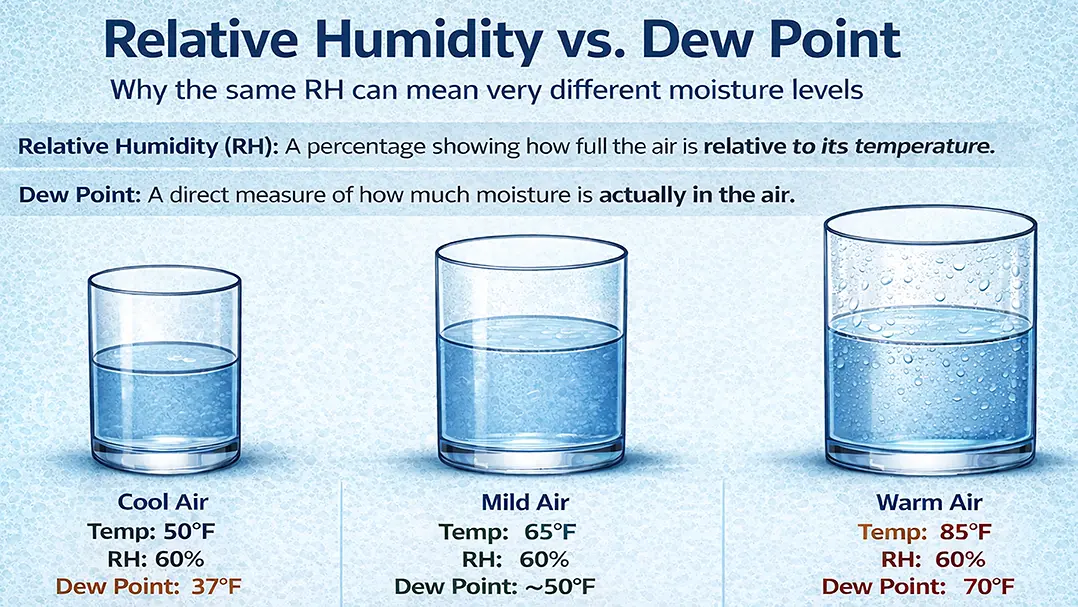
This is the essential distinction:
Relative humidity describes moisture at a given temperature.
Dew point predicts whether moisture will accumulate.
Let’s look at a couple of examples.
Example: High Humidity, Low Dew Point
Here’s a scenario you may see outdoors:
-
Temperature: 50°F
-
Relative Humidity: 75%
-
Dew Point: 42°F
The relative humidity appears high, but the dew point shows the air contains very little moisture. By itself, this outdoor reading does not determine whether ventilation is beneficial.
To know if this air will help, it must be compared to the conditions inside the crawl space. If the crawl space has a higher dew point, introducing this outdoor air can help reduce moisture because it still has the capacity to absorb water vapor.
This commonly occurs during spring and fall and illustrates why dew point comparisons—not relative humidity alone—determine whether outdoor air will dry the space or add moisture.
Example: Moderate Humidity, High Dew Point
Contrast that with a warm summer afternoon:
-
Temperature: 85°F
-
Relative Humidity: 60%
-
Dew Point: 70°F
The humidity percentage appears acceptable, but the dew point shows the air is already moisture-laden. Without comparing indoor and outdoor conditions, this air may increase moisture rather than reduce it.
A simple way to understand dew point is to picture a cold drink sitting outside in summer. Water forms on the outside of the glass because warm, humid air around it is cooling and releasing moisture. A crawl space works the same way. When air with a high dew point enters a cooler environment, moisture comes out of the air and accumulates on surfaces.
Why Dew Point Should Be the Standard for Crawl Space Moisture Evaluation
Dew point is valued because it provides a direct measure of water vapor. It removes confusion caused by temperature shifts and offers a clearer, more actionable understanding of moisture conditions.
By prioritizing dew point, homeowners and professionals gain:
-
A more accurate understanding of moisture behavior
-
Better guidance on when ventilation will reduce moisture
-
Protection from introducing air that increases moisture levels
-
Insight that RH alone simply cannot provide
Dew point is the most reliable predictor of moisture outcomes inside a crawl space, making it an important measurement for long-term moisture protection.
Why ATMOX

Understanding dew point in crawl space moisture control helps you recognize real moisture risk. This is where ATMOX brings clarity and science together. The ATMOX system continuously measure temperature, humidity, and dew point inside and outside the crawl space. By comparing these real-time readings, the system determines when outdoor air has true drying potential and when it would increase moisture levels inside the space. When the outdoor dew point is lower than conditions inside the crawl space, the system uses ventilation to help reduce moisture. When outdoor dew points are too high, ventilation is restricted to prevent moisture accumulation. ATMOX operates as a controlled ventilation system, so the vents remain closed during these periods. The system can signal a connected dehumidifier to run when additional moisture reduction is needed, providing targeted control when outside air is not suitable for drying.This dew-point-driven approach offers a more intelligent, targeted, and protective way to manage moisture year-round.
To learn how ATMOX uses dew point to support better crawl space moisture control visit our Contact Us page at atmox.com. Our team is ready to help you understand your options and make the best choice for protecting your crawl space.
