
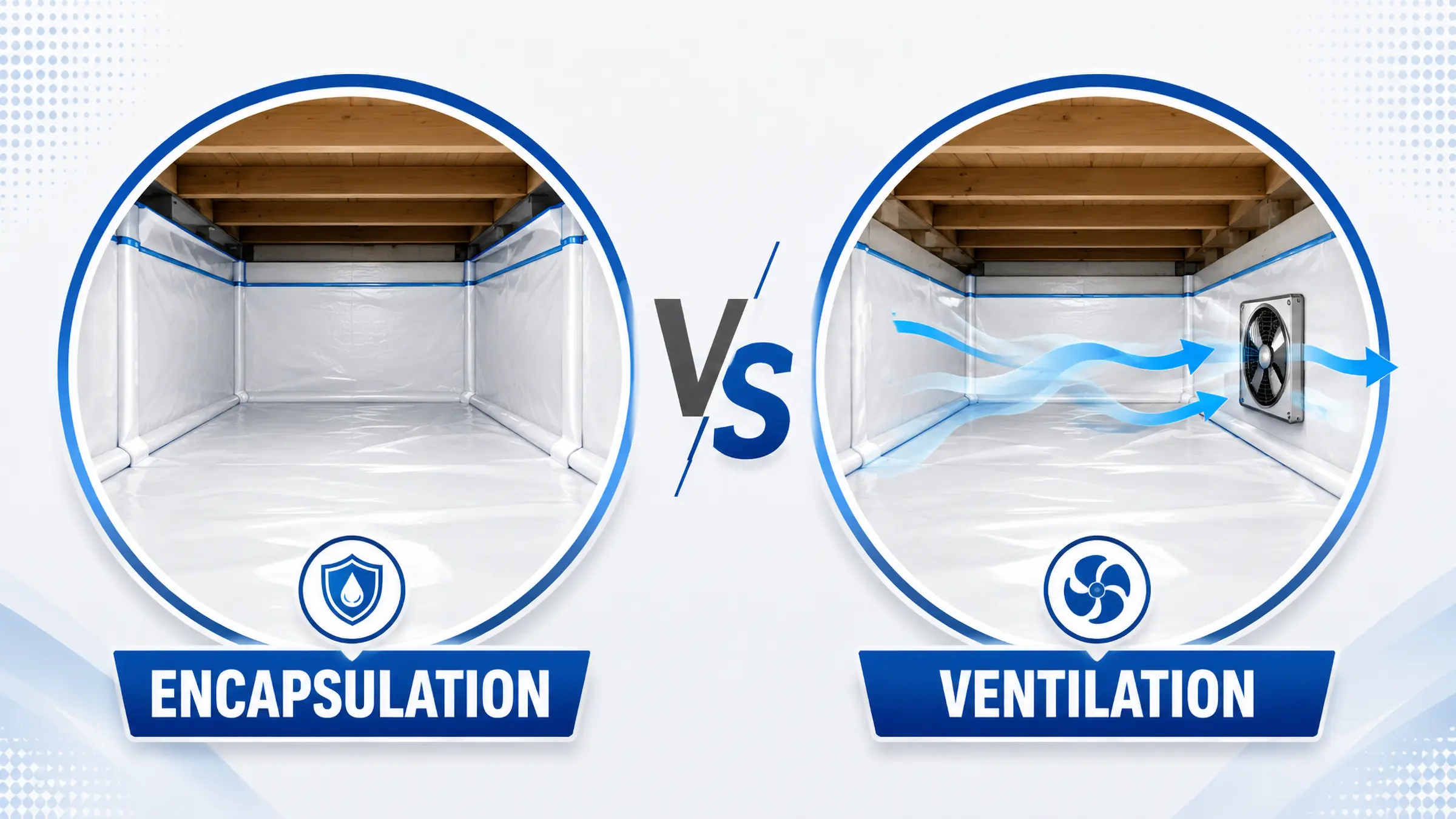
This is a hot topic in the crawl space industry. You hear it all the time: encapsulation vs. ventilation. Some people believe the crawl space should be closed up completely. Others believe ventilation is still important. The conversation can quickly turn into an “us versus them” debate.
But maybe there is actually less to debate than we think.
Before deciding which side is right, it helps to stop and ask a simple question: What do we actually mean when we say encapsulation? And what do we actually mean when we say ventilation?
That may sound basic, but it matters. A lot of the confusion in this conversation comes from the fact that people are using the same words in very different ways.
What Does Encapsulation Really Mean?
When someone says a crawl space is encapsulated, they may not always mean the same thing.
To some people, encapsulation means there is a vapor barrier covering the ground. To others, it means the vents have been closed. For some, it means the vapor barrier runs up the walls and the crawl space is sealed more completely. Others may include insulation, sealed vents, a dehumidifier, drainage work, and air sealing as part of the full encapsulation process.
So when we say “encapsulation,” we need to be careful. Are we talking about a basic vapor barrier and sealing the vents? Are we talking about a fully sealed crawl space with a dehumidifier? Or are we talking about something in between?
This is one reason the debate gets confusing. People are often arguing from different definitions.
What Does Ventilation Really Mean?
The same thing happens with the word ventilation.
When some people hear ventilation, they think of open foundation vents where outside air moves in and out passively. Others may think of manually opening and closing vents depending on the season. Some may think of temperature-controlled vents. Others may think of fans that move air in and out of the crawl space.
Then there is a more advanced option: ventilation that is intelligently controlled. That means the system is not just moving air because a vent is open or because a fan is running. It is making a decision based on the actual conditions inside and outside the crawl space.
That is a very different type of ventilation.
Passive ventilation and controlled ventilation should not be treated like they are the same thing. They are not. One depends on whatever the outdoor air happens to be doing. The other looks at the conditions and determines whether the outside air is actually helpful.
This is where the conversation needs more clarity.
Why the Debate Gets Framed as “Us Versus Them”
One reason this turns into an encapsulation versus ventilation debate is because everyone is using these words differently. One person may be thinking of open vents and damp summer air. Another person may be thinking of a sealed crawl space with no air exchange. Another may be thinking of smart ventilation that only operates when outdoor air can help dry the space.
Those are not the same things.
Another reason is geography. Crawl spaces are not all dealing with the exact same conditions. Weather patterns are different from one region to another. Construction styles are different. Soil conditions are different. Seasonal moisture issues are different. What works well in one area may need to be adjusted in another.
That does not mean the basic science changes. Moisture still behaves like moisture. Dew point still matters. Air still moves. But the way a solution is applied may look different depending on the home, the climate, and the condition of the crawl space.
There is also a difference between theory and actual execution. It is one thing to build a new home and apply building science principles from the beginning. It is another to walk into an existing home, with existing construction, existing water issues, old vents, tight access points, insulation problems, uneven grading, and years of moisture history.
Retrofit work is not always clean and simple. A crawl space contractor often has to work with what is already there. That is why a real-world moisture control solution needs to be practical, not just theoretical.
The Fundamentals Still Come First
No matter what you call the solution, the fundamentals of moisture control do not really change.
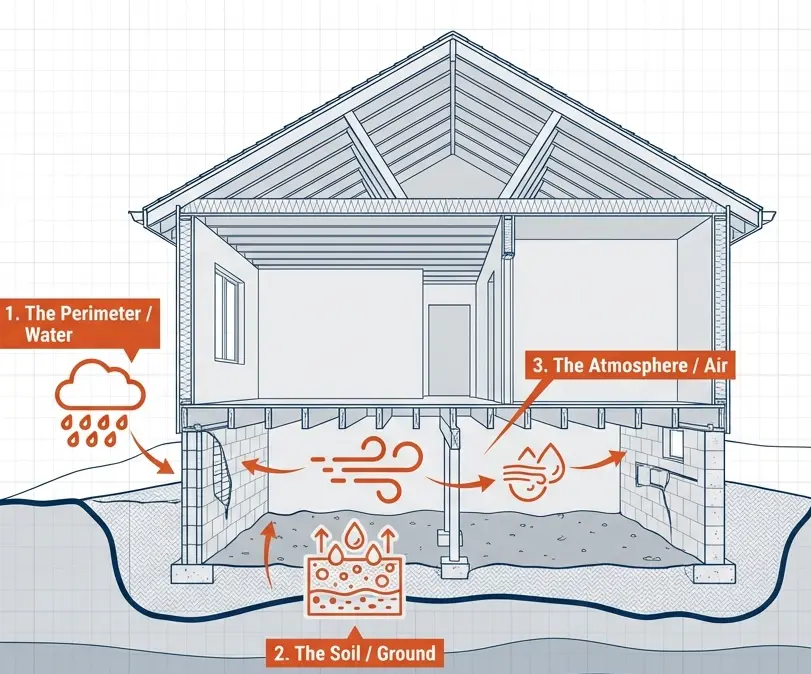 First, you have to stop bulk water intrusion. If water is entering the crawl space from drainage problems, plumbing leaks, grading issues, foundation cracks, or standing water, that has to be addressed first. No ventilation system, dehumidifier, or vapor barrier can fully solve a water problem that has not been corrected.
Second, ground moisture has to be controlled. This is where a good vapor barrier matters. Moisture from the ground can continuously add humidity to the crawl space. Covering the ground properly helps reduce that moisture load.
Third, the crawl space needs some type of drying action. This is where the conversation usually turns to ventilation, dehumidification, or a combination of both.
So in many ways, the industry is already on the same page about the first two steps. Stop water intrusion. Reduce ground moisture. The bigger question is what happens next.
How do you control the air in the space?
The Role of Ventilation
Ventilation can be very helpful, but only when the air being brought into the crawl space is actually better than the air already in the crawl space.
That is the key point.
Outdoor air is not automatically good or bad. It depends on the conditions. When the outside air is drier and has the ability to help remove moisture from the crawl space, ventilation can be a very effective drying method. It can help reduce moisture, exchange stale air, and improve the overall environment under the home.
This matters because the air in the crawl space does not always stay in the crawl space. Air can move upward into the living space through the stack effect, gaps, penetrations, and natural air movement in the home. So the quality of air underneath the home can affect the air above it.
That is one reason ventilation should not be dismissed completely. There is significant value in air exchange when it is done at the right time and under the right conditions.
Ventilation can also be an energy-efficient drying method because it uses favorable outdoor air when nature is already providing it. If the outside air can help dry the crawl space, it makes sense to use that opportunity.
The problem is not ventilation itself. The problem is uncontrolled ventilation.
Why Passive Ventilation Falls Short
With passive vents, the crawl space does not get to decide when outdoor air enters. The vents are open, and the air comes in based on weather, wind, pressure, and temperature differences.
Sometimes that air may help. Other times, it may add moisture.
That is especially important during warm, humid weather. Air that feels normal outside can still carry a lot of moisture. If that air enters a cooler crawl space, it can raise humidity and contribute to condensation or damp conditions.
This is why many people became frustrated with traditional vented crawl spaces. Open vents do not know whether outdoor air is helpful. They simply allow air exchange.
The same concern applies to systems that only use a humidistat inside the crawl space. A humidistat can measure the relative humidity inside the space, but it does not tell you whether the outside air is better or worse. If a fan turns on only because the crawl space humidity is high, but the outside air is even more moisture-laden, then the system may pull in air that makes the problem worse.
That is why the decision cannot be based only on inside humidity. The system needs to know what is happening outside too.
Intelligent Moisture Control
This is where controlled ventilation changes the conversation.
With an intelligent moisture control system, you can get the benefits of ventilation without leaving the crawl space open to whatever the outdoor conditions happen to be.
The system can compare the conditions inside the crawl space to the conditions outside. It can look at temperature, relative humidity, and dew point. That matters because dew point gives a clearer picture of the actual moisture in the air.
When the outside air is favorable for drying, the system can ventilate. When the outside air is not helpful, the vents can remain closed. In that case, the crawl space is protected from bringing in additional moisture.
This is very different from passive ventilation.
Instead of saying “vents should always be open” or “vents should always be closed,” intelligent control asks a better question:
Is the outside air helpful right now?
That is a much more practical way to manage a crawl space.
Where Dehumidification Fits
Dehumidification can also play an important role in crawl space moisture control. In many homes, it may be needed as part of the drying strategy, especially when outside air is not favorable for ventilation.
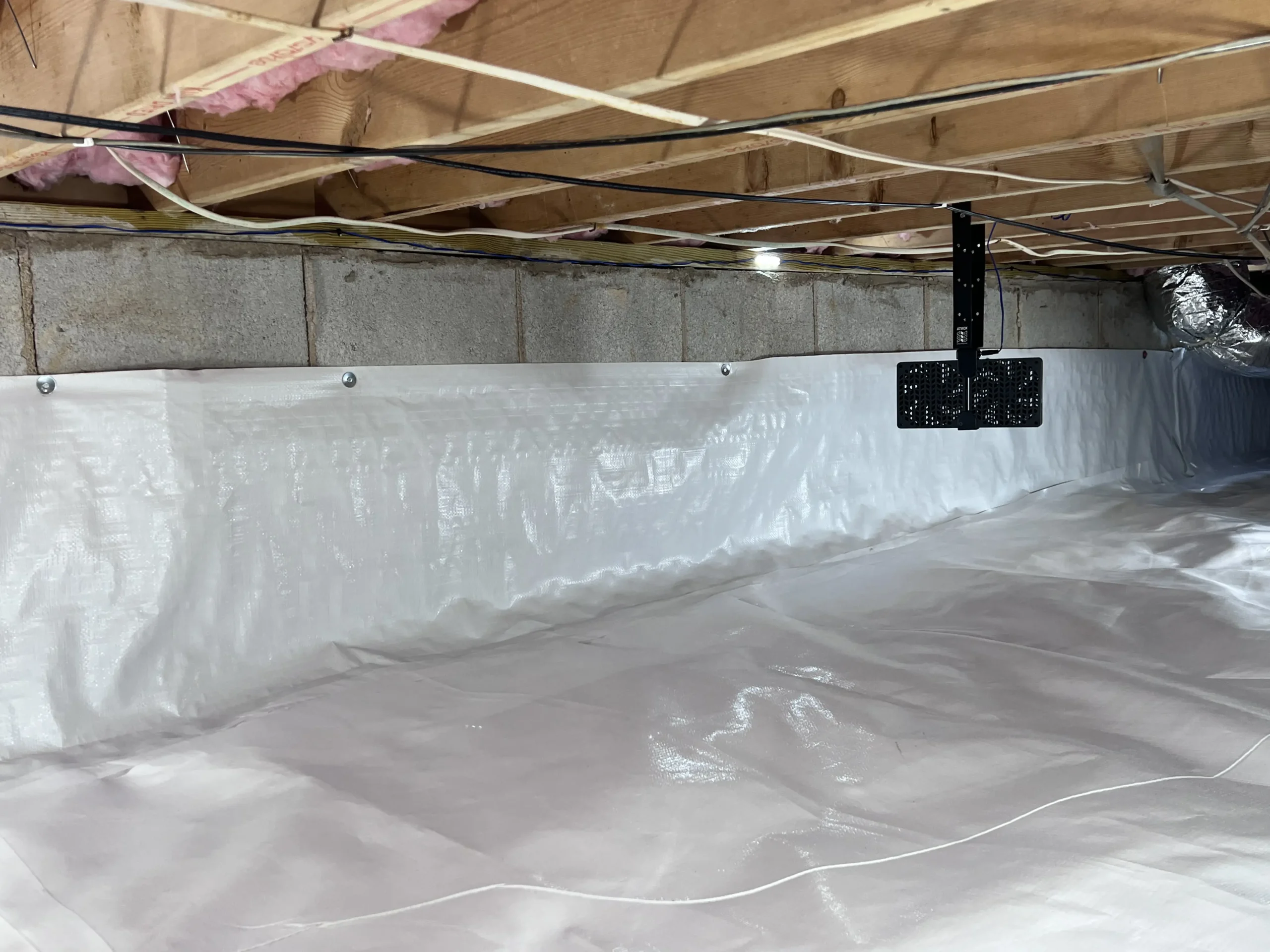
But even with a dehumidifier, air movement still matters. A dehumidifier can only dry the air that reaches it. Crawl spaces are often divided by beams, piers, corners, additions, and tight areas where air does not move evenly. Without good circulation, some areas may stay damp even when a dehumidifier is running.
That is why internal circulation fans are beneficial. They help move air throughout the crawl space, including into the nooks and crannies that are easy to miss. This helps create more even drying throughout the space.
With an ATMOX system, ventilation and dehumidification do not have to compete with each other. They can work together. The system can use favorable outdoor air when it is available and use the dehumidifier as backup drying when outside air is not beneficial.
That is a more complete approach.
Encapsulation and Ventilation Can Work Together
This is why the phrase “encapsulation vs. ventilation” can be misleading.
The two are not actually opposites.
A crawl space can have a vapor barrier. It can be sealed from ground moisture. It can have vents that remain closed when outside air is not helpful. It can also have controlled ventilation that operates when the outside air can help dry the space. It can have internal fans to move air throughout the crawl space. It can have a dehumidifier that runs when mechanical drying is needed.
Those parts can work together.
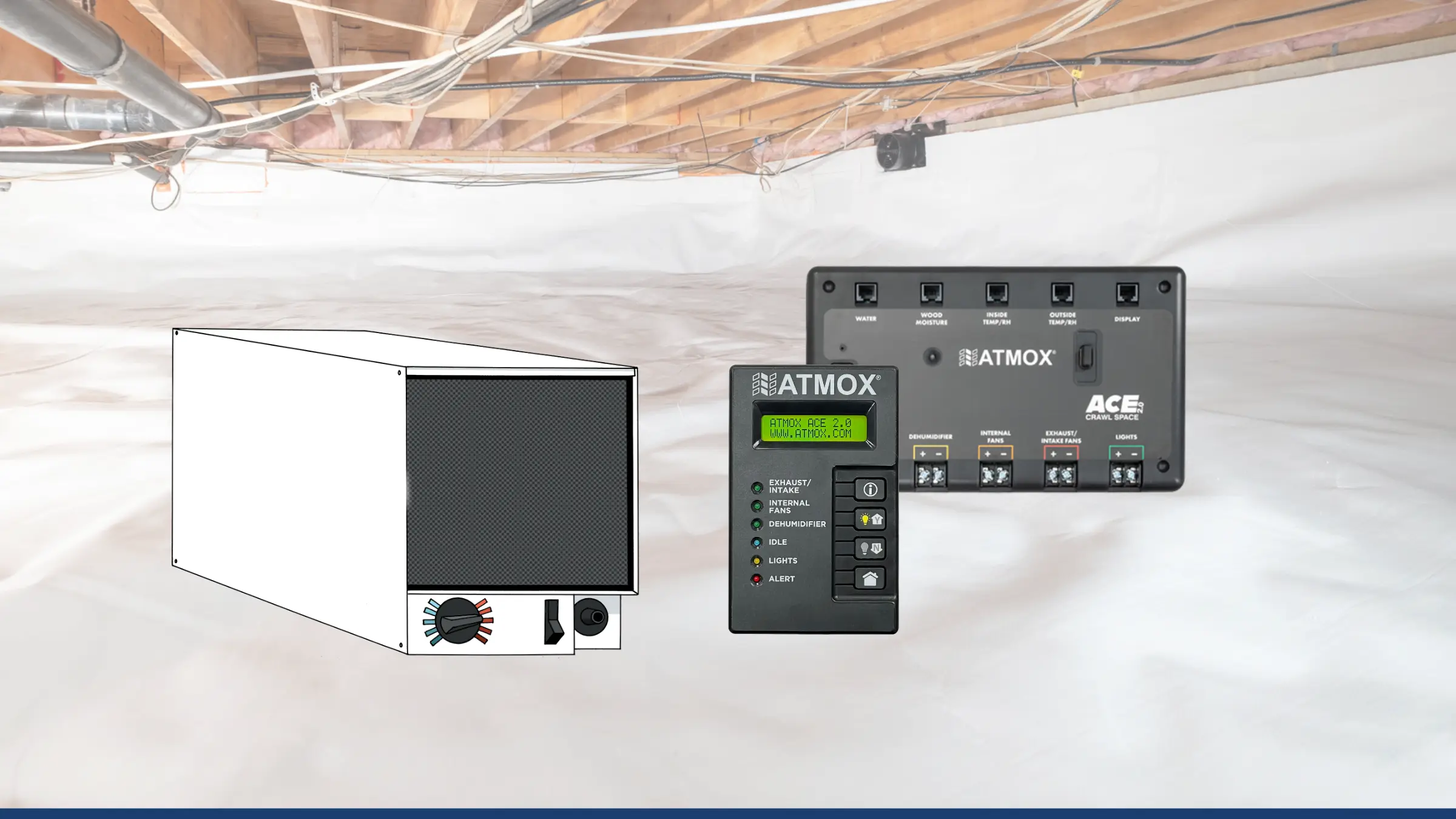 In fact, for many crawl spaces, that combination may be the better way to think about moisture control. It is not about choosing one side of an industry debate. It is about controlling the conditions under the home.
The real question is not whether encapsulation or ventilation is always right.
The better question is: What does this crawl space need to stay dry, healthy, and controlled?
The Practical Debate
If we step back, most people in the industry agree on more than they disagree on.
Everyone agrees that standing water is a problem. Everyone agrees that ground moisture needs to be reduced. Everyone agrees that damp crawl spaces can lead to bigger issues like wood rot, mold growth, pest attraction, and poor air quality. Everyone agrees that the crawl space environment matters.
The disagreement usually comes down to how the air should be managed.
At ATMOX, we believe the answer is not simply to leave the crawl space open or to close it up and ignore ventilation altogether. The answer is to control the space intelligently.
That means using outdoor air when it helps. Keeping outdoor air out when it does not. Moving air throughout the space so there are fewer damp pockets. And using dehumidification when additional drying is needed.
That is not encapsulation versus ventilation.
That is encapsulation and ventilation working together as part of a controlled moisture strategy.
And once you look at it that way, the debate starts to feel a lot less like two opposing sides and a lot more like a conversation about how to do the job well.
