

When homeowners think about home maintenance, the crawl space often goes unnoticed. Yet this tucked-away area beneath the home plays a vital role in your home’s structural integrity, indoor air quality, and energy efficiency. Over the years, building practices have evolved, and so has our understanding of how to best manage this space—especially when it comes to controlling moisture.
Today, the most effective approach combines intelligent crawl space ventilation with encapsulation. While encapsulation seals off the crawl space from outside air and ground moisture, proper ventilation ensures air quality and moisture levels remain in check.
What Is Crawl Space Encapsulation?
Encapsulation is the process of sealing the crawl space to create a controlled, dry environment. This process typically includes installing a proper vapor barrier along the floor and walls and sealing any foundation vents. There are different methods to complete this, so it’s important to consult with your installer about their specific approach. The main objective is to isolate the crawl space from the outside environment to reduce moisture intrusion.
By itself, encapsulation offers several benefits:
- It reduces the amount of moisture entering from the soil.
- It creates a buffer against outdoor humidity and weather changes.
- It helps regulate the temperature beneath the home.
However, vapor barrier alone will not resolve all potential moisture problems. The closed space needs a drying action which is typically done through the use of a dehumidifier. However, without a way to ventilate the air within the encapsulated space, stale air can still build up. Over time, this can lead to odors and poor air quality—even within an encapsulated space.
Why Moisture Control in the Crawl Space Matters
Moisture is the leading enemy of crawl space health. High humidity can result in mold and fungus growth, wood rot, pest infestations, and even damage to the flooring system above. Worse, studies show that as much as 40–50% of the air in your crawl space flows up into your home. This “stack effect” means that the air you breathe indoors is often impacted by the air quality below your floors.
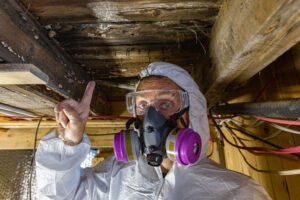
Left unchecked, a damp crawl space can contribute to
- Respiratory irritation or allergies from mold growth
- Musty odors that creep into the living space
- Unwanted pests attracted to moisture
- Cupping or warping of hardwood floors
- Expensive structural repairs
Crawl space ventilation is such a powerful tool in the fight for improved air quality and against moisture—and why pairing it with encapsulation and its dehumidifier is an optimal combination.
The Problem with Passive Crawl Space Ventilation
In older homes, crawl spaces were built with open vents designed to allow passive ventilation. The idea was that air from outside would flow through the space and dry it out naturally. But, this method can do more harm than good because it doesn’t take into account the condition of the outside air.
Recognizing this flaw, many regions began shifting toward sealed crawl spaces with encapsulation. However, without ventilation or air movement, closed crawl spaces can still harbor trapped moisture and air contaminants.
Ventilation with Encapsulation
The best way to manage crawl space conditions is to combine encapsulation with intelligent crawl space ventilation. This approach allows for a true control of the sealed space by limiting negative effects from outside while introducing beneficial airflow to remove humidity and improve air quality.
Ventilation strategy for encapsulated crawl spaces

Controlled ventilation combines encapsulation with air exchange using both intake and exhaust fans. Fresh outside air is brought into the crawl space only when conditions are favorable—typically when it is cooler and drier than the air inside. When conditions are not suitable, the system remains closed. Sensors monitor both indoor and outdoor conditions to determine the optimal times for ventilation. This approach improves air quality by replacing stale air with fresh air and, when the outside air is dry, it can also serve as an effective and energy-efficient way to reduce moisture in the crawl space.
This balanced ventilation strategy mimics how nature dries out wood and soil—with a cycle of dry air exchange. In spring, fall, and winter, the outside air is often drier and cooler than the air inside the crawl space, making it ideal for drying. A well-designed system can monitor dew point levels and only operate when drying is possible, saving energy and improving effectiveness.
Why This Combination Works So Well
Pairing intelligent crawl space ventilation with encapsulation tackles the moisture problem from both ends. Encapsulation limits how much moisture enters the space from the ground and exterior walls. Controlled ventilation removes any humidity that does make its way in and promotes healthy airflow.
Here’s what this combo accomplishes:
- Controls moisture levels within the crawl space.
- Protects structural components from potential wood rot and damage.
- Improves indoor air quality by preventing the buildup of airborne contaminants.
- Reduces pest activity by removing moisture that attracts them.
- Decreases demand on dehumidifier use in turn reducing electricity usage.
Ventilation and Indoor Air Quality
When we talk about moisture control, we’re also talking about air quality. Crawl spaces can trap VOCs (volatile organic compounds), soil gases and odors. Just reducing humidity doesn’t eliminate these pollutants—they must be removed through air exchange.
Just like using an exhaust fan when cooking in the kitchen, the crawl space needs a way to vent out stale, contaminated air. Balanced crawl space ventilation makes this possible by introducing clean air and expelling unwanted pollutants.
If you want a long-term, energy-efficient solution for moisture and air quality in your home, crawl space ventilation with encapsulation is the gold standard. It protects your home’s structure, improves indoor air, and boosts energy efficiency.
Learn more about this solution.
